
Wind is the first question
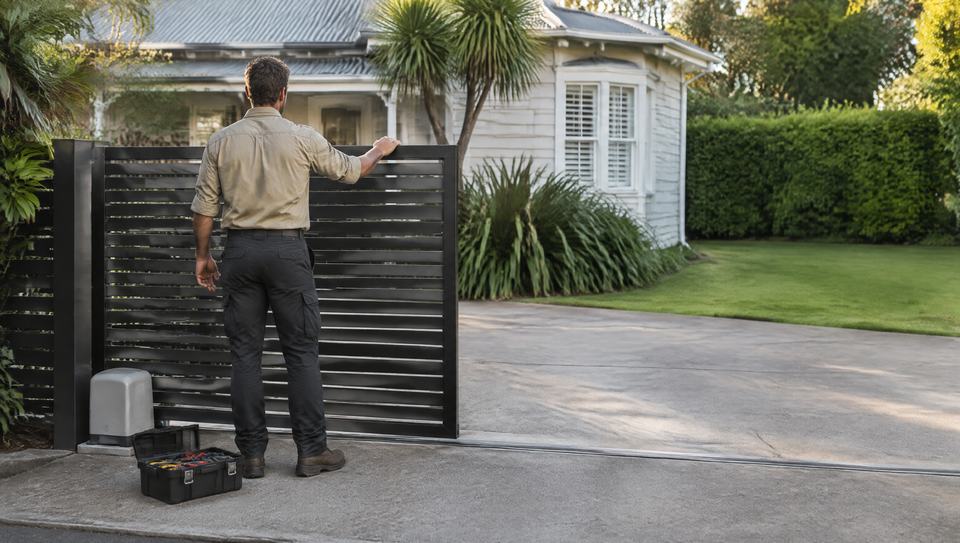
Wellington Airport averages 25.8 km/h of wind and records gusts over 96 km/h on 24 days a year, NIWA says. A tall solid electric gate is a sail in that sort of weather, whether it slides or swings.
So raise it early. Tell the door specialist which way the gate faces, how it sits against the southerly and the northerly, and whether it is solid or open. Ask what the gate motor is rated for and how it behaves if a gust holds the gate back part way.
A gate motor for a sloping site
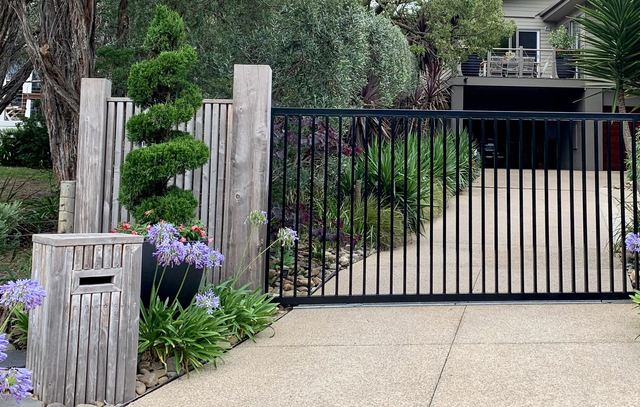
If your driveway slopes, that shapes the choice. A swing gate needs clear ground through its whole arc, so a rise in the driveway can stop it short. A sliding gate usually wants a level run along the fence. Neither is impossible on a hill, but one will usually fit better.
Whichever you pick, the gate must be sound first. The NeoSlider manual asks for a well balanced gate that a person can move with no more than 15kg of force. Dominator's sliding openers go to 500kg and 6m wide, or 800kg and 8m wide, and for swing gates it offers the Elite SGO-1 with a DC motor.
When the power goes
Automatic gates depend on power, and Wellington storms can cut it. The June 2013 storm left 30,000 homes without electricity, NIWA says. If your only way off the section is through the gate, a battery matters.
Dominator sells battery backup for its NeoSlider openers, and SmartSolar packages for gates far from the house. Merlin also has a solar powered rural gate opener. Ask how the gate is released by hand too, and make sure everyone at home knows how.
Wiring and safety beams
New power at the gate is fixed wiring, so it goes to a licensed electrician, who gives you a Certificate of Compliance no more than 20 days after the work. The NeoSlider manual also says a qualified electrician must do the install where 240V is used, with a weatherproof 10 amp outlet close to the opener.
The same manual strongly recommends safety beams, and they need a cable underground across the gateway. On a steep drive with a retaining wall or concrete, that takes some planning, so get it into the first conversation.
Electric gates around Wellington
South coast and ridges
NIWA has Baring Head on 255 days a year of gusts over 63 km/h, so homes on that coast should plan for wind on the gate most weeks.
Harbour salt
Within 500 m of the coast or harbour sits Zone D, BRANZ says, so a gate there needs the same care as a seaside garage door.
The Hutt Valley
Wallaceville, in the Hutt Valley, averages just 9.1 km/h, so a gate there may have an easier time of it than one on the ridges.

What we would do
Ask for the gate to be tested on a windy day, not a still one. A motor that looks fine on a calm afternoon may falter or stop in a southerly, and it is easier to have the settings looked at while the door specialist is still handing the job over.