
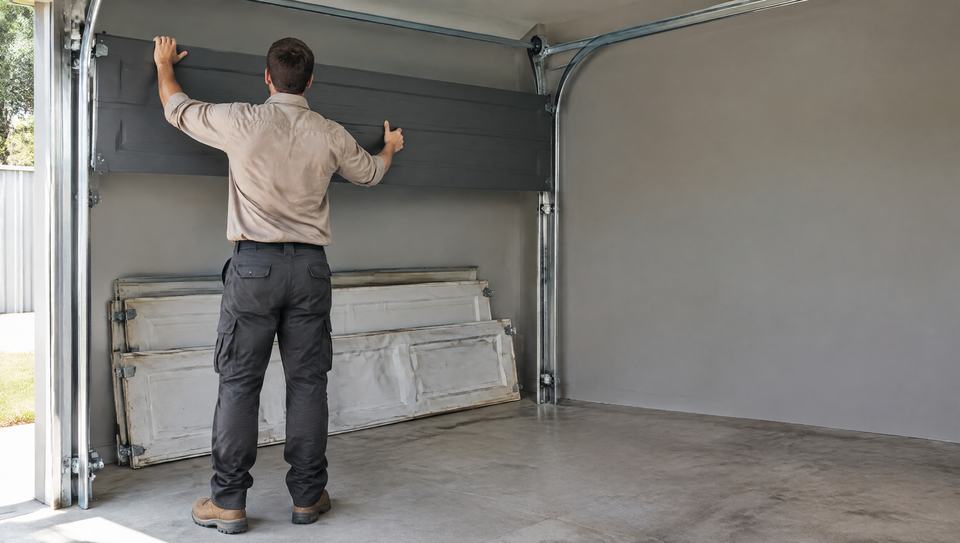

Repair it or replace it?
Replacing starts to make sense when repairs keep coming back, when the panels or curtain are rusting through, or when the door no longer suits how you use the garage.
Have the springs and tracks looked at before you decide. A door that is only out of balance can often be put right, while one that is corroded or bent is a better candidate for replacement. Dominator's door warranties don't cover damage from salty or damp conditions, which is worth knowing on an older coastal door.
Replacing an old tilt door
If your garage has a one-piece tilt door, there is more than one way to replace it. Dominator sells its Flex-A-Door for exactly this: a roller curtain on a curved track that needs only 80mm of headroom with its retractable head infill panel, or 130mm with an opener. Sectional and roller doors are the other choices, depending on the room above and beside the opening.
Tilt door springs need respect on the way out. B&D NZ says they are always under tension, and only approved B&D dealers with the proper tools should adjust or repair them, so taking an old tilt door down is not a DIY job either.
Measuring for the replacement
Measure the opening's width and height, then the headroom from the top of the opening to the ceiling, the sideroom on each wall and the depth back into the garage. Dominator lists 400mm of headroom, 80mm of sideroom and 450mm of backspace for its Series A roller door, which shows the kind of figures that decide what fits.
Dominator makes each door to the exact size of the opening, so expect the door specialist to measure again before anything is ordered.
Keep the motor or change it?
An opener that suited the old door may not suit the new one. Dominator's Select, Secure, Smart and Smart Pro openers are for sectional and tilt doors, and its Excel is for roller doors, so going from a tilt door to a roller door means a different motor.
Weight counts as well. Dominator rates the Smart and Secure for doors up to 235kg and the Smart Pro up to 300kg, and it notes that insulation adds weight to a door. If the new door is heavier than the old one, ask whether the existing opener is rated for it.
Building consent and the council
MBIE's guidance says replacing a building product with a comparable one in the same position can go ahead without a building consent, but it never names garage doors. It also says doors in an external wall must usually last at least 15 years, and replacing one that has failed inside that time needs a consent.
So ask your council about your own door before work starts, and read the garage door rules for what MBIE's guidance covers.
An old door is still under tension
The springs and cables on the old door stay loaded until someone trained takes the tension off. Garador says not to touch the drums or the cables, and Dominator's manual warns that the door and its hardware can cause serious injury.
What you can do, and what to leave
You can
- Measure the opening and the space around it
- Note the make and model of the current opener
- Clear the garage near the door before the day
- Ask the council about consent
Leave to a door specialist
- Taking the tension off and taking down the old door
- The final measure and the order
- Installing and balancing the new door
- Reprogramming or swapping the opener
- New wiring, by a licensed electrician

What we would do
Photograph the label on the opener and the space above the opening before you send the job. With the motor's model and a view of the headroom, the door specialist can tell you on the first call whether the opener can stay and which doors will fit.