
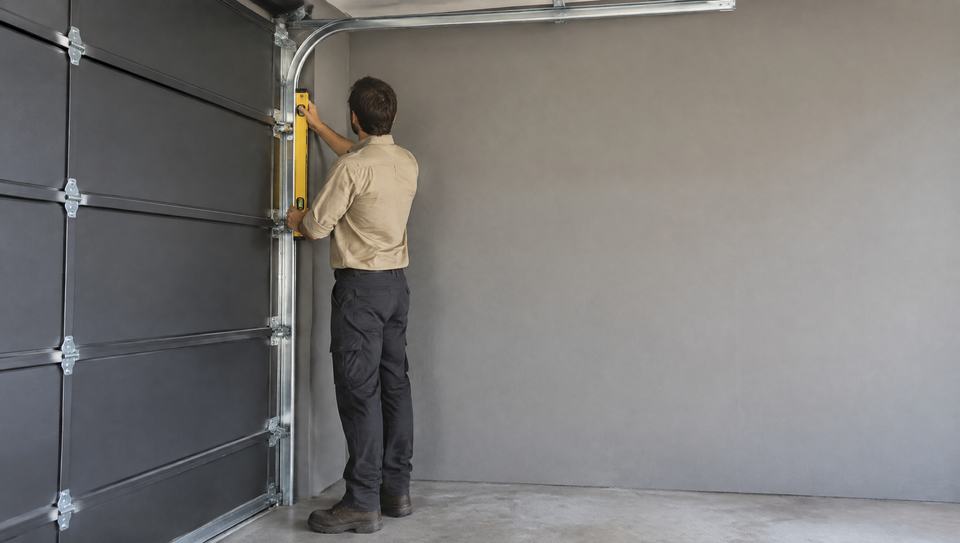
Why there is no set roller door size
Dominator, one of the B&D NZ brands, says all of its doors are made to order here from New Zealand steel, and each one is custom made to fit the exact size of the opening.
That turns the usual question around. Rather than a standard single or double size, what matters is the range a maker can build and whether your opening sits inside it. The bigger differences from one garage to the next are in the space around the opening, and that is where most roller door questions get settled.
Dominator Series A roller door figures
| What Dominator lists | |
|---|---|
| Height | 1300mm to 3200mm |
| Width | 1250mm to 3200mm |
| Headroom | 400mm |
| Sideroom | 80mm, or 135mm with an opener |
| Backspace | 450mm |
| Steel | 0.4 BMT, in Zincalume or pre-painted |
Small openings and very wide ones
For a small opening, check the bottom of the range first. The Series A starts at 1250mm wide and 1300mm high, so for anything narrower or lower, ask the door specialist what can be made before you settle on a roller door.
At the other end, the Series A tops out at 3200mm in both directions. Past that width, the published roller range runs out, and a sectional door is the next one to ask about: B&D NZ builds those up to 6.5 metres wide. The single and double garage doors page covers widths across every door type, while this guide stays with roller doors.
Headroom: the space for the drum
A roller door's curtain winds up onto a drum above the opening, so the gap between the top of the opening and the ceiling decides whether one fits at all. Dominator gives 400mm of headroom for its Series A.
When the ceiling sits lower than that, B&D NZ points to the Flex-A-Door, which runs the same kind of curtain on a curved track that lies flat near the ceiling instead of rolling up. Dominator's Flex-A-Door gets by with 80mm of headroom, or 130mm with a motor, and at least 100mm at the sides.
Motors that mount on the end of the drum add one more limit, on the axle the drum turns on. Merlin's MR855EVO manual and ATA's GDO-6 V4 manual both put the widest axle they fit at 35mm.
Sideroom and backspace
Sideroom is the wall beside the opening, where the drum's brackets sit and where a motor goes on one end. The Series A asks for 80mm, rising to 135mm on a door with an opener.
The motor makers' manuals show why that extra space matters. ATA's GDO-6 manual recommends 135mm from the curtain edge to the inside of the door bracket and 175mm to the wall, with 41mm and 85mm as the bare minimum, and it wants the full 135mm where a battery backup is fitted. Dominator's Excel needs at least 41mm, and Merlin's MR855EVO at least 45 mm between the curtain edge and the bracket.
Backspace is the depth the rolled-up door takes behind the opening. Dominator lists 450mm for the Series A, so look for lights, shelving or pipes fixed inside that depth.
If the door will have a motor
An opener brings its own size limits. Dominator rates its Excel roller door opener for a door up to 3.25 turns of the drum wheel high, which it puts at about 3000mm, with an area of 16.5 square metres and a weight of 110kg. Merlin's manual for the MR855EVO lists doors up to 4.5 m high, 18 square metres of curtain and 120 kg.
So a big door that runs fine by hand may still need checking against the motor's figures before it is ordered. Balance matters as much as size. B&D NZ's care guide says a roller door should take no more than 15kg of effort to move by hand, and Dominator says an opener is only meant to stand in for human strength. More on choosing one is on the roller door motors page.
Leave the old door to the door specialist
Swapping a roller door means taking down a door that is held by springs. Dominator's opener manual says garage doors, springs, brackets and their hardware are under extreme tension and can cause serious injury, and not to attempt any adjustment. Garador puts it plainly: do not attempt to adjust springs. Measure as much as you like, but leave the door, the drum and the brackets alone.
What to tell the door specialist
- The width at the narrowest point and the height at the lowest
- The headroom from the top of the opening to the ceiling, or to whatever hangs lowest
- The room on each side of the opening, and which side has the power point
- How much depth there is behind the opening for the rolled-up door
- Whether you want a motor now, or might add one later
- Photos of the opening from inside the garage
Your part, and the door specialist's
You can
- Measuring width, height, headroom, sideroom and backspace
- Taking photos of the opening, inside and out
- Noting anything fixed near the top or sides of the opening
- Deciding whether a motor is likely
Leave to a door specialist
- Checking the measurements before the door is ordered
- Taking down the old door, its drum and brackets
- Fitting the new drum, brackets and curtain
- Fitting and setting up a motor
- A new power point, by a licensed electrician

What we would do
If a motor is even a maybe, say so before the door is ordered. The sideroom Dominator lists for its Series A goes from 80mm to 135mm once an opener is fitted, and that space is far easier to plan for now than to find after the door is up.